Showing posts with label Women. Show all posts

Thursday, July 24, 2008

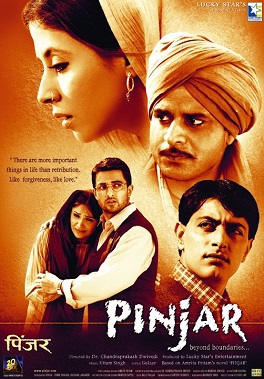
Pinjar


Pinjar, starring Urmila Matondkar in perhaps her most significant role, suffers occasionally from some low production values and spotty direction. But the subject the movie deals with is so stirring that this doesn't matter after you've seen the film. Form and beauty and technical perfection are just side-factors for this film; its main subject matter is powerful enough to keep the viewer fascinated with horror and distaste for hours after the film ends.

The film's theme is isolation. Its atmospheric fear stems from the society's pervasive oppression, and rejection, of women. Identifying with Puro (Urmila's character), the viewer slowly becomes aware of the level of isolation a woman was (and still is) subject to in traditional "honour"-oriented societies with a tribal social structure which regard women as property. The Partition of India, which led to some of the worst civic atrocities of the 20th century, enhances and completes the isolation. Puro's sense of being stranded alone among aliens drives the emotional charge of this movie.

Set in 1946, just before Partition, the film is about Puro, the eldest daughter of a Punjabi Hindu family, spending her time with her mother, sisters and a doting brother whom she is particularly close to. Puro's life is a picture of perfect family bliss until her father brings his family to their native village to settle her marriage. Unknown to Puro, her ancestors, who had been dominant in the village two generations ago, visited atrocities on the Muslims two generations ago. Times have changed now: Muslims are dominant in the village and are thirsting for some payback. This sets Puro up for a horrifying ordeal: she is abducted by a Muslim man, Rashid (Manoj Bajpai), and slowly loses all hope of being reunited with her family (or indeed anyone from Hindu society).

Manoj Bajpai was consummate as Rashid; I find it surprising the Bollywood doesn't use him more. Urmila did a good job with Puro. With most of the other actors I had a vague sense that they were a little wooden. But I hardly noticed this; it is just a vague impression in the back of my mind, which was almost completely absorbed by the events that were depicted. This is a movie where it is hard to separate the quality of performances from the subject matter. The same is true for the sets and realization of the surroundings; some of them looked inauthentic, like stage sets. The music in this movie was atrocious, and songs burst out of nowhere in the most incongrous Bollywood style possible. The entire first half-hour was over-developed and forgettable. But the story was so absorbing that all of this didn't matter.

To me, Pinjar was very educational about an alien aspect of North Indian (and Pakistani) culture. I once spoke with an expert on South Asia who gave me a convincing explanation for women-as-property attitude. Historically, for warring tribes that needed constant supplies of warriors, women were valuable as child-bearing instruments; so valuable that it was acceptable to abduct women for their child-bearing potential. These attitudes persist in some regions of Northern India and Pakistan even today; stories about abduction of Hindu women in Pakistan still appear from time to time in newspapers. (Presumably the same attitudes ossified and later included atrocities such as honour killings.) Pinjar depicts the extent to which such abductions had become part of the culture: everyone is depicted as being complicit in the abductions; entire villages colluded to hide abductees from government authorities. Paradoxically, the abducted women are not treated unkindly; they are in fact encouraged to integrate and lead "productive" lives. The unkindness is restricted to the abduction.

There are a few other aspects of the movie worth mentioning, such as Rashid's reluctance: he doesn't want to abduct Puro, but his family's "honour" demands it. Bajpai captures Rashid's conflicted personality well. The various depictions of other atrocities during the times of partition, such as the large scale killings, also stand out. Two scenes in particular come to mind. The first is the palpable tension when Ramchand (Sanjay Suri), Puro's erstwhile fiancee, runs from a frenzied mob after Partition is announced in 1947. The other is the sense of utter helplessness when Lajjo (Sandali Sinha), Ramchand's sister, is abducted right in front of him from a supposedly secure police-protected refugee camp. There's one scene where Puro meets her parents after being abducted; it was probably the strongest scene but for some reason struck me in a surreal rather than visceral way. The movie does have moments of reconciliation as well towards the end, but in some ways they were as disturbing as the rest of the film. In Stockholm-syndrome-esque ending, Puro reveals the extent to which she is tied emotionally to her new life with Rashid. Even though I know this is what really happened with scores of Hindu abductees, it is still hard for me as a viewer to accept or believe at an emotional level.

Pinjar should not be watched for its film-making brilliance (it's got too many flaws) or its entertainment value (those elements are seriously inferior in this film). It should be watched to get a small sense for the terrors experienced by people and abductees and their families during Partition.

Saturday, July 12, 2008

Dor


Nagesh Kukunoor is an interesting director. He has made some very relevant and beautifully directed movies, like his debut Hyderabad Blues and the tight and complex 3 Deewarein. But he has also directed some absolute disasters like the forgettable Hyderabad Blues 2 and the truly odious Bombay to Bangkok, upon watching which you wonder how it could possibly be the same director. Luckily Dor falls unequivocally in the first category.

Dor is a story of two women, Meera (Ayesha Takia) and Zeenat (Gul Panag), whose lives and outlooks are opposites, though not quite diametrical. Meera lives in a stark desert landscape of sun-bleached sands in Rajasthan while Zeenat lives in a lush green mountain town in Himachal Pradesh. Meera is the bahu of a traditional Hindu family, constrained to live austerely under a ghoonghat serving her in-laws. Zeenat is a progessive, independent, forward looking Muslim woman, living in a house of her own, dismissive of her in-laws' misgivings about her. While Meera is childlike and young at heart, Zeenat is worldly-wise and mature for her age. There is no conflict between Meera and her in-laws, but they view her almost as property. Zeenat has a conflicted relationship with her in-laws, but they come to love and respect her.

Meera's and Zeenat's fates become intertwined when their husbands set off for Saudi Arabia in search of better financial prospects; an incident there has Zeenat traveling across the country to find Meera. The relationship between the two women and secret conflict underlying that relationship form the basis for the rest of the movie.

This movie is all about connecting with the viewer emotionally, but it is hard to summarize its emotional tone in a sentence. Kukunoor handles the various changes, from bliss to tragedy, and the various moments of joy and despair, deftly. The pall that is cast over the two women is lifted occasionally in various bursts of joy, with some comic relief mixed in. The underlying tension and unhappiness disappear and reappear intermittently throughout the movie, but return poignantly towards the end. A major focus of the movie is the problems faced by women in overly traditional settings, and it manages to convey these travails to the viewer very well.

The completeness of the movie is quite impressive. It grabs your interest and doesn't let go. The pacing is a bit uneven, but this doesn't diminish the viewing experience much. The cinematography is great and serves to both emphasize the beauty of and the differences between the two types of landscape in the film. Both the lead actresses, as well as the supporting cast do excellent jobs; the only lacklustre performance in this movie is that of Kukunoor himself in his cameo role as a businessman. Gul Panag does well in picking meaningful roles and is a good actress. Ayesha Takia does very well in her role as Meera. A minor grouch that I had was with the casting: while their acting was great, neither Gul Panag nor Ayesha Takia were quite able to capture the rustic personalities required of their characters. Takia is just a tad too glamorous; Panag is just a bit too assertive. Shreyas Talpade is adequate in his role as a thief-turned-good-samaritan.

I would categorize this as a must-watch movie: it has a message, is a study of certain situations, and at the same time manages to be entertaining.

Saturday, August 11, 2007

Chuk De India: Pleasantly different from most Bollywood fare!


Shimit Amin seems to be shaping up as one of India's best directors. This is his second movie, and both were excellent, multi-faceted and multi-layered movies. According to wikipedia, Chuk De India received mostly negative reviews from film critics -- scores of 2/5 and the like. Perhaps the critics are a big impediment to good cinema in India. This movie is definitely up there, just a little below Lagaan and other classics.

Chuk De India is a movie with hockey as a central theme, but it is about much, much more than hockey. It makes statements on so many levels that it is worth spending some time on them.

Most Bollywood films are not really pan-Indian in spirit. They divide India into zones:
  • "India": The "real" India consists only of Maharashtra, Punjab, Rajasthan, UP and to a lesser extent Bihar, Bengal and, especially in older films, Kashmir.
  • "South India": Everyone living "over there" is a "Madrasi". According to Bollywood, these are weirdos who have heads smeared with vibhooti and start their sentences with "AAAIY AAIYA JEE... AAMA AATA JEE..." type nonsense popularized by Mehmood and assiduously cultivated by Bollywood ever since.
  • Nonexistent India: The rest of India, especially the North East (Assam, Tripura, Sikkim, Nagaland, Arunachal, Manipur, Mizoram, Meghalaya), Orissa, and to some extent MP are completely left out of all Bollywood films.
First of all, this movie lampoons stereotypes (which, sadly, Bollywood propagates).
  • It actively seeks to break the South Indian stereotype, but it does fall short: it makes the common mistake of pronouncing and spelling "Telugu" as "Telegu". This shouldn't have happened in a film that is making it a point to show that Telugu is not the same as Tamil. But that's really nitpicking, the spirit was right.
  • We see much more of Europe, America and Australia in Bollywood films than some parts of our own country. This film features individuals from Manipur and Mizoram and makes it a point to note that they are as Indian as anyone else. Again, the film falls a little short of the mark: none of the people who are not from traditional Bollywood's "core India" get a major role.
  • In India, Cricket is treated as being the only worthwhile sport. A lot of characters in the film look down upon hockey -- an impediment that the players have to face. It was an interesting decision to use hockey instead of cricket in the movie. Director Shimit Amin handles this very well. By the middle of the movie, I was quite excited about hockey.
Next, this movie makes a very strong statement on women's rights. This forms a theme that runs throughout the movie: the women are expected to give up what they want for families and boyfriends. None of this is over the top; it is handled with fine balance, showcasing the frustration of women who are on the edge of something great but have no one to share it with, least of all their families.

For a change from typical Bollywood movies, all of the characters are developed well in this movie. Each one has a little story, ordinary but interesting. The team members' quirks are alternately amusing and aggravating. The interactions between the members of the team are normal -- seniors bullying junior players, people taking a dislike to each other because of some initial incident, cliques and factions with grouches against each other or against the coach. Much of the movie is a well-paced story about how the players and coach gradually grow to like each other and come together as a team.

Shah Rukh Khan is finally displaying what a good actor he is. He always had the potential, but for the first 10 years or so of his career chose films requiring fairly ridiculous "M-M-M-Main-Main T-T-T-Tu-Tu" type stuttering as a substitute for comedy and an identical persona in roles that were really quite varied. I didn't like him in those years, but his role in Swades was great. In Chuk De India, his character is not fleshed out in much detail. The character had an incident when he was a hockey player 7 years before the main events of the movie, was branded a traitor and had to go into hiding, a button that's easy to push. For most of the movie, he is a tough, impassive coach: a role that doesn't require much acting. But for all that, Shah Rukh handled the role reasonably well.

Chuk De India also has high levels of realism, a quality Amin also displayed in his Ab Tak Chchappan. Indian sports movies typically feature actors who very obviously can't play the sport. Most of the realizations of Indian scenes are unrealistically glamorous: posh bathrooms,designer clothes, and over-the-top attitudes are pleasantly missing from this movie. Chak De India's actors look like they can actually play hockey. And they behave and live like real Indians. And the facilities in the movie look like real Indian facilities. When the team ends up in Australia, the scenes there and the reactions of the Indian team are very believable.

The sport itself is showcased much less that I would have liked. Although the nature of the movie draws the audience into the game, there are no cool hockey moves or tricks, nothing that would excite anyone actually interested in the game itself. None of the type of magic that prompted officials to inspect Dhyan Chand's hockey stick! There are some scenes where the coach plans strategy with the players, but these are just atmospheric scenes. The strategies are not shown in the movie. This is the one area where I felt the movie could have done better.

Overall, it was a fantastic movie. India needs more movies as balanced as Chuk De India, and it needs more directors like Shimit Amin.