Showing posts with label Hindi. Show all posts

Friday, November 7, 2008

Fashion


It's unusual to see a realistic portrait of a human being disintegrating mentally in and Indian film. It's been done a few times, for example in Maine Gandhi Ko Nahin Maara starring Anupam Kher. Fashion is a movie where this is done with two different people.

Fashion is a movie that depicts the highs and lows achieved by the people in the modeling and fashion industry. It's a film that portrays various aspects of its primary topic. The glitter is in evidence but it's just a mood-setter in this movie, a thinly brushed-on veneer of glamour-paint. Most of the movie is about the weaknesses of the human character: the arrogance that comes with easy success, the meanness and lack of strength exposed when success turns to failure. It's hard to find a single cliche in this movie. There are many movies that show people descending to low levels because of a mental sickness; this movie shows what being in an industry like the fashion industry can do to healthy, normal minds. The movie often makes the viewer think about what's going on.

The unfortunate thing is this happens only in parts of the movie. Although the topics and writing are great and handled well, I found the movie gripping only in parts. It's hard to put a finger on it, but some parts are just a tad too bland to grasp attention. This could've been a great movie, but it ended up being merely good.

Sunday, July 27, 2008

Observation/Rant #003

The Era of Godfathers

It's interesting how gangsters and mafias have taken over significant portions of the film industry.

Ten years ago that comment would have meant something different: gangsters were financing films in a big way back then. That has changed, partially thanks to the official classification of the Bombay film industry as an industry, which makes film financing through regular means easier.

What I mean here is gangster films: movies that have Bombay-style mafias and gangsters as a central plot element. I don't quite know which movie started the trend: early ones include Parinda, Satya and Company. I think of Satya as the one that started the trend, though Parinda was an earlier film. The trend migrated from Bombay to the Telugu film industry. At least, I think that's the direction it went although Ram Gopal Varma - director of Satya - started off in Hyderabad.

I view this genre as separate from other movies which feature outlaws in central roles, such as Robin Hood-themed films. The gangster genre usually has a remarkably uniform depiction of gangster organizations. There's an all-powerful ganglord surrounded by subservient subordinates at various layered levels. There are a few trusted lieutenants, some people below them, and the rank and file. Some films within this genre depict the gangsters as fundamentally honourable people, others depict them as lacking any sense of ethics, so perhaps you could divide it into sub-genres.

What's amazing is the number of films featuring such organizational setups, both in Bombay and Hyderabad.

Thursday, July 24, 2008

Hindi Movies to Avoid

Here are some bad Hindi movies that I had the misfortune to watch. A 1-star rating means that I would unwatch this movie if I could. A 2-star rating means it's still pretty bad, but (depending on your tolerance level) you won't feel like you've been tortured mentally after watching it.
  1. Hyderabad Blues 2 (2 star). Silly and aimless but not horrible.
  2. Bombay to Bangkok (1 star). Why would Kukunoor do this to his own reputation?
  3. Heyy Babyy (1 star). Akshay Kumar had a few good movies, but seems to be picking only bad ones nowadays.
  4. U, Me aur Hum (1 star). Tries to be meaningful and talk about Alzheimer's disease, but is mostly just obnoxiously bad Bollywood masala. Should've known as soon as I saw the atrocious Hinglish title.
  5. Kisna (2 stars). At least there's some rope Mallakhamb to watch.

Hindi Movies to Watch

Here's a non-exhaustive list of Hindi movies I enjoyed, in no particular order (so far). Most of them are recent, meaning post-1995; I've marked older movies. Movies I've written about are linked. I might add star ratings and sort them in some order later, and will keep adding good movies that I watch.
  1. Dor
  2. Pinjar
  3. Iqbal
  4. Taare Zameen Par
  5. Chuk De India
  6. Johnny Gaddar
  7. Om Shanti Om
  8. Awara (pre-1995)
  9. Jaane Tu... Ya Jaane Na
  10. Dharm
  11. Manorama: Six Feet Under
  12. 3 Deewarein
  13. No Smoking
  14. Water
  15. Earth
  16. Hyderabad Blues
  17. The Blue Umbrella
  18. Taxi No. 9211
  19. Swades

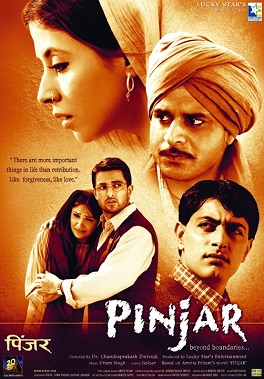
Pinjar


Pinjar, starring Urmila Matondkar in perhaps her most significant role, suffers occasionally from some low production values and spotty direction. But the subject the movie deals with is so stirring that this doesn't matter after you've seen the film. Form and beauty and technical perfection are just side-factors for this film; its main subject matter is powerful enough to keep the viewer fascinated with horror and distaste for hours after the film ends.

The film's theme is isolation. Its atmospheric fear stems from the society's pervasive oppression, and rejection, of women. Identifying with Puro (Urmila's character), the viewer slowly becomes aware of the level of isolation a woman was (and still is) subject to in traditional "honour"-oriented societies with a tribal social structure which regard women as property. The Partition of India, which led to some of the worst civic atrocities of the 20th century, enhances and completes the isolation. Puro's sense of being stranded alone among aliens drives the emotional charge of this movie.

Set in 1946, just before Partition, the film is about Puro, the eldest daughter of a Punjabi Hindu family, spending her time with her mother, sisters and a doting brother whom she is particularly close to. Puro's life is a picture of perfect family bliss until her father brings his family to their native village to settle her marriage. Unknown to Puro, her ancestors, who had been dominant in the village two generations ago, visited atrocities on the Muslims two generations ago. Times have changed now: Muslims are dominant in the village and are thirsting for some payback. This sets Puro up for a horrifying ordeal: she is abducted by a Muslim man, Rashid (Manoj Bajpai), and slowly loses all hope of being reunited with her family (or indeed anyone from Hindu society).

Manoj Bajpai was consummate as Rashid; I find it surprising the Bollywood doesn't use him more. Urmila did a good job with Puro. With most of the other actors I had a vague sense that they were a little wooden. But I hardly noticed this; it is just a vague impression in the back of my mind, which was almost completely absorbed by the events that were depicted. This is a movie where it is hard to separate the quality of performances from the subject matter. The same is true for the sets and realization of the surroundings; some of them looked inauthentic, like stage sets. The music in this movie was atrocious, and songs burst out of nowhere in the most incongrous Bollywood style possible. The entire first half-hour was over-developed and forgettable. But the story was so absorbing that all of this didn't matter.

To me, Pinjar was very educational about an alien aspect of North Indian (and Pakistani) culture. I once spoke with an expert on South Asia who gave me a convincing explanation for women-as-property attitude. Historically, for warring tribes that needed constant supplies of warriors, women were valuable as child-bearing instruments; so valuable that it was acceptable to abduct women for their child-bearing potential. These attitudes persist in some regions of Northern India and Pakistan even today; stories about abduction of Hindu women in Pakistan still appear from time to time in newspapers. (Presumably the same attitudes ossified and later included atrocities such as honour killings.) Pinjar depicts the extent to which such abductions had become part of the culture: everyone is depicted as being complicit in the abductions; entire villages colluded to hide abductees from government authorities. Paradoxically, the abducted women are not treated unkindly; they are in fact encouraged to integrate and lead "productive" lives. The unkindness is restricted to the abduction.

There are a few other aspects of the movie worth mentioning, such as Rashid's reluctance: he doesn't want to abduct Puro, but his family's "honour" demands it. Bajpai captures Rashid's conflicted personality well. The various depictions of other atrocities during the times of partition, such as the large scale killings, also stand out. Two scenes in particular come to mind. The first is the palpable tension when Ramchand (Sanjay Suri), Puro's erstwhile fiancee, runs from a frenzied mob after Partition is announced in 1947. The other is the sense of utter helplessness when Lajjo (Sandali Sinha), Ramchand's sister, is abducted right in front of him from a supposedly secure police-protected refugee camp. There's one scene where Puro meets her parents after being abducted; it was probably the strongest scene but for some reason struck me in a surreal rather than visceral way. The movie does have moments of reconciliation as well towards the end, but in some ways they were as disturbing as the rest of the film. In Stockholm-syndrome-esque ending, Puro reveals the extent to which she is tied emotionally to her new life with Rashid. Even though I know this is what really happened with scores of Hindu abductees, it is still hard for me as a viewer to accept or believe at an emotional level.

Pinjar should not be watched for its film-making brilliance (it's got too many flaws) or its entertainment value (those elements are seriously inferior in this film). It should be watched to get a small sense for the terrors experienced by people and abductees and their families during Partition.

Sunday, July 20, 2008

Iqbal

This is yet another brilliant offering from Nagesh Kukunoor. Like a good chef, he takes a simple recipe and executes it perfectly with good ingredients to produce a great result. The actors and technical departments are top-quality, the story is original and refreshingly simple, and the direction is perfect.

Iqbal is the story of a deaf-mute village boy, born at the moment of India's 1983 Cricket World Cup triumph (or perhaps when Kapil Dev won the semi-final match against Zimbabwe almost single-handedly). Iqbal has an innate but unschooled talent for cricket. The story is about his struggles to learn the game overcoming his own physical limitations, his father's restrictions, and the political intricacies of cricket academies; and whether he can triumph over the many obstacles that come in his way.

The film excels in its immersive realization of the its environment. The setting of the film is that of a village somewhere in India, where Iqbal spends his days tending his father's buffaloes. The story-telling in this movie and its pacing are in harmony with the simplicity of the environment. It is a very textural movie. You can almost feel the grass under your feet when Iqbal gets ready to bowl. The dull thud you hear when Iqbal drives his makeshift tree-branch stumps into the ground almost convinces you you can smell the sap. You can almost smell the haystack on which Iqbal's mentor Mohit (played by Naseeruddin Shah) wakes up after a night of drunkenness. When Iqbal first walked into Mohit's shadowy ancestral British-era haveli, I could almost feel the dank coolness inside. I've never seen a small-town cricket training academy or stadium, but after watching this movie, I imagine I have a feel for what they must be like.

This is one of those rare films where many different actors get a lot of screen time. Shreyas Talpade as the title character Iqbal dominates the screen for most of the time, of course, but the other actors' characters are all very well-developed as well. Shweta Prasad excels in the role of Khadija (Iqbal's sister). Naseeruddin is superb as Mohit; you can almost feel his drunken character's hangover each morning. Girish Karnad gives a balanced performance as the political Guruji, capturing the character's ambiguous morality. Prateeksha Lonkar and Yateen Karyekar are perfect as Iqbal's parents. But the star is, of course, Shreyas Talpade. Talpade seems to work with Kukunoor a lot, and it seems like one of those win-win professional relationships. This movie really showcases how fine an actor Talpade really is. It's hard to describe it all, but there's no single place in this movie where what he does looks the least bit unusual. His look of mild incomprehension at conversations he can't hear, his moments of elation, perplexity, gloom and his usual neutral good cheer, Talpade does them all, neither underdoing nor overdoing them.

And now for my pet peeve with Indian sports movies: again, this movie fails to showcase the sport it is based on. This movie may have captured the spirit of the cricket institutions themselves. But I would have loved to see some insane inswingers or yorkers. I wanted to see Iqbal scalp Kamal's (Adarsh Balakrishna) wicket with a ball so good that I'd burst out in spontaneous applause. These could have been bowled by a mainstream bowler and sliced in with Talpade's action. To Talpade's credit, he has a pretty reasonable bowling action. But the ball trajectories are played down a bit and they are nothing to write home about. In this context, I am reminded of the excellent football movie Goal starring Pele and Sly Stallone. I'd like to see a movie with that kind of reverence for the technical game itself.

This is not the kind of film that induces extreme emotional responses. It is low-key, not designed for one-a-minute thrills, maudlin emotional blows or cringe-inducing evil. Even the worst character in the movie (Guruji) is simply political, not evil or malevolent or even particularly antagonistic towards Iqbal. This movie treats its subject matter with respect. But that doesn't mean it's dry or fails to connect with the viewer. It's highly enjoyable, realistic cinema.

Sunday, July 13, 2008

Johnny Gaddar


There's been a spate of new movies coming my way lately. What's surprising is many of them are good. After Dor, Manorama Six Feet Under and Dharm, I got my hands on Johnny Gaddar.

Soon after watching the movie, I re-read Jabberwock's brief review of that movie, and checked out director Sriram Raghavan's Rediff slide show on his inspirations for the film. (I'm guessing this film isn't inspired in the usual Bollywood sense of lifting scene ideas directly from other films; to put it pompously, it pays homage to those films.) I must say I Sriram Raghavan sounds very learned on films; I hadn't even heard of 8 out of the 10 films he cites. So, unfortunately, I might be missing out on several homage elements and similarities that I could otherwise have drawn. I'm not too upset about this, because I enjoyed the film tremendously for what it is.

Johnny Gaddar is the story of five crooks who are about to pull off some sort of deal brokered by a corrupt policeman; the deal isn't made clear but it doesn't matter to the film. They have to invest 50 lakhs each and are supposed to get back 100 lakhs after the deal. The five have a sort of "coalition dharma": they're in it together. But one of them plots to decamp alone with all of the money as well as the wife of one of the others, with whom he is having an affair.

I was struck by how carefully thought out the plot was. The plot is the weak point in most Indian movies. It usually lacks innovation, or if it has innovation, lacks coherence. On the rare occasions when it has both, there are still many other ways for the filmmaker to mess things up: Johnny Gaddar has a great (though uncomplicated) plot and manages to keep all the other things together as well. The sequence of events is carefully thought out, and though some discussions online point to seeming inconsistencies, I didn't agree with those discussions and wasn't able to find any inconsistencies of my own.

Building on the foundation of a good plot, Raghavan handles the various turns and characters deftly. He avoids some common pitfalls such as pacing or detail erraticism. The film moves along at a good clip, and the pace doesn't flag disappointingly anywhere. As well, the level of detail is consistent throughout the film; unlike so many other directors, Raghavan doesn't get tired and take shortcuts in some chunks of the movie. This doesn't mean the level of detail is exactly the same throughout the film; that would just be boring. Rather, detail is added when a certain emotional effect is sought, but not arbitrarily reduced. The viewer is kept engaged right until the end.

Apropos of which, the ending is a grouch that I often have on many Indian (and even foreign) films. If the sequels to The Matrix had displayed any signs of above-invertebrate intelligence, the world would be a different place today. If Anurag Kashyap hadn't gone berserk in the second half of No Smoking, we'd have a true modern masterpiece to boast of in Hindi cinema. I think this inability to think through a great ending is a natural human failing: it's easier to create a mystery (which just requires you to think up something out of the ordinary) than to solve it satisfyingly (which requires you to logically reconcile that extraordinary invention with the ordinary). Even Arthur C. Clarke came up against this wall when he tried to write sequels to Rendezvous with Rama. Raghavan, of course, isn't quite as ambitious in this film; nevertheless it doesn't diminish the satisfying ending he was able to create. What struck me was that you know what's going to happen, but the suspense stays with you until the director chooses to reveal it, to the very second. You don't guess it a minute before, 10 seconds before or even a nanosecond before Raghavan tells you about it.

The tone of the film is dark, in keeping with the incidents in its plot; but visually it runs the gamut from traditional noir chiaroscuro to bright bubblegum tones. One thing I was really impressed with was Raghavan's ability to create a mood. It reminded me of Anurag Kashyap's evocative visual brilliance in No Smoking. Johnny Gaddar isn't quite as superlatively evocative, but it's halfway there, and its medium is screen movement rather than visual style per se. Two memorable scenes are the train scene where elements that every Indian is familiar with are brushed onto the viewer's senses: the peculiar carriage movement of the Indian train, the flashes of light and dark out the window, the small railway platforms quickly passed, the sudden rushing onset of bridge trusses and other trains. Many movies have this scene, but the elements picked out in this movie are best-of-class. An excellent demonstration of Raghavan's abilities is the tension created by the approach of the ticket collector during the train sequence. Another scene is the apartment search by Zakir Hussain's character (identified by Jabberwock). Again, it is a scene familiar through firsthand experience for most of us viewers: the frustration of futilely searching for something you know must be there, the racking of brains to think of another place it might be, the brief flare of hope when a previously overlooked spot is identified, and the crashing despair of a dashed hope.

Now while this film has many things going for it, it is a low key film. "Exciting" would be a wrong word to use, though "gripping" is right. In other words, while you feel with the protagonist, it doesn't evoke emotional highs from the viewer. That's not necessarily a bad thing; I'm just trying to explain what type of movie it is.

The performances by the entire cast are very competent. Dharmendra seems to have drawn a lot of flak online for his dialogue delivery and his English, but I actually thought his way of talking was pretty natural. The interestingly named Neil Mukesh, in his first film, does a great job of depicting both his fear and determination.

Overall, it's one of those films I would put in the "must watch" category.

Saturday, July 12, 2008

Dor


Nagesh Kukunoor is an interesting director. He has made some very relevant and beautifully directed movies, like his debut Hyderabad Blues and the tight and complex 3 Deewarein. But he has also directed some absolute disasters like the forgettable Hyderabad Blues 2 and the truly odious Bombay to Bangkok, upon watching which you wonder how it could possibly be the same director. Luckily Dor falls unequivocally in the first category.

Dor is a story of two women, Meera (Ayesha Takia) and Zeenat (Gul Panag), whose lives and outlooks are opposites, though not quite diametrical. Meera lives in a stark desert landscape of sun-bleached sands in Rajasthan while Zeenat lives in a lush green mountain town in Himachal Pradesh. Meera is the bahu of a traditional Hindu family, constrained to live austerely under a ghoonghat serving her in-laws. Zeenat is a progessive, independent, forward looking Muslim woman, living in a house of her own, dismissive of her in-laws' misgivings about her. While Meera is childlike and young at heart, Zeenat is worldly-wise and mature for her age. There is no conflict between Meera and her in-laws, but they view her almost as property. Zeenat has a conflicted relationship with her in-laws, but they come to love and respect her.

Meera's and Zeenat's fates become intertwined when their husbands set off for Saudi Arabia in search of better financial prospects; an incident there has Zeenat traveling across the country to find Meera. The relationship between the two women and secret conflict underlying that relationship form the basis for the rest of the movie.

This movie is all about connecting with the viewer emotionally, but it is hard to summarize its emotional tone in a sentence. Kukunoor handles the various changes, from bliss to tragedy, and the various moments of joy and despair, deftly. The pall that is cast over the two women is lifted occasionally in various bursts of joy, with some comic relief mixed in. The underlying tension and unhappiness disappear and reappear intermittently throughout the movie, but return poignantly towards the end. A major focus of the movie is the problems faced by women in overly traditional settings, and it manages to convey these travails to the viewer very well.

The completeness of the movie is quite impressive. It grabs your interest and doesn't let go. The pacing is a bit uneven, but this doesn't diminish the viewing experience much. The cinematography is great and serves to both emphasize the beauty of and the differences between the two types of landscape in the film. Both the lead actresses, as well as the supporting cast do excellent jobs; the only lacklustre performance in this movie is that of Kukunoor himself in his cameo role as a businessman. Gul Panag does well in picking meaningful roles and is a good actress. Ayesha Takia does very well in her role as Meera. A minor grouch that I had was with the casting: while their acting was great, neither Gul Panag nor Ayesha Takia were quite able to capture the rustic personalities required of their characters. Takia is just a tad too glamorous; Panag is just a bit too assertive. Shreyas Talpade is adequate in his role as a thief-turned-good-samaritan.

I would categorize this as a must-watch movie: it has a message, is a study of certain situations, and at the same time manages to be entertaining.

Thursday, July 10, 2008

Manorama Six Feet Under


Falling vaguely between a Western and a moody detective thriller (those in the know call it 'Noir'), Manorama Six Feet Under is a gripping and suspenseful movie. It is the story of a struggling writer/bureaucrat named Satyaveer (played by Abhay Deol) who meets a woman named Manorama, who gives him a mysterious message and then disappears. Satyaveer spends most of the movie trying to figure out what was going on and getting involved in crime, politics, and much more than he bargained for.

Abhay Deol seems to make better movie choices than his cousins Sunny and Bobby (another memorable one was his role in Ahista Ahista). Unfortunately, the intelligence of these roles is in inverse proportion to the performance of his movies at the box office. I hope he doesn't get scared off doing good movies. He carries off his role in this movie quite well, that of a jaded government servant bored by everything in his life. The dryness of his life mirrors that of the desert. Gul Panag, who plays his wife in this movie, is very good as well -- although her personality is a little too strong for the role she plays. She doesn't quite fit the small-town housewife mould. The director managed to extract a pretty good performance from all of the other actors as well; there isn't a bad performance in this film.

Manorama is an atmospheric movie, mirroring the dry, slow, soporific desert in which the story is set. The movie does a great job of holding its suspense right until the end. The main problem, as I see it, is with the ending itself. A good mystery unravels in front of the audience like a multiply-wrapped gift as the movie progresses. But Manorama fails in this: while a few tidbits are thrown at the audience throughout the movie, the main mystery is simply explained verbally by Satyaveer at the end.

Nevertheless, the bad ending and sedate pace don't diminish this film much. It is a gripping, highly watchable, well-directed thriller.

Tuesday, July 8, 2008

Jaane Tu... Ya Jaane Na


Watched this movie at the local 'plex yesterday. Jaane Tu... is the story of two friends, just friends, very close friends, who decide to help each other find the ideal partner after graduating from college. The movie is supposed to be post-college, but it's actually reminiscent of the Freddie Prince Jr. type high-school comedies that come out of Hollywood. The flavour of the movie is romantic, escapist fun, and it succeeds very well. It's set in and around Bombay: an airbrushed, extra colourful, attractive Bombay, with attractive, chic people. The humour throughout the movie is nice. You laugh because situations are funny, not because the actors are going out of their way to make fools of themselves. The jokes occur naturally at various points in the movie. There's a lot of romance, and the good-looking, positive-attitude cast draw you in. The flashback narrative style jars occasionally, with focus shifting between the people who are telling the story and the dramatization of the story itself -- but it's not too bad.

The story does need some suspension of analytics. The events, characters and settings are recognizable rip-offs from various Hollywood movies; there's very little innovation going on here. But the director does a great job of blending the elements together: within the universe of the movie, the elements are natural and not jarring. One thing that really struck me was Imran Khan's Freddie Prince Jr. act -- his clothes, hair, behaviour, everything seemed to be a copy! And what's with the wimpy guy KOing a 2nd degree black belt?

Still, nothing is too over the top, and you can immerse yourself in this movie for a good couple of hours of fun, without cringing at some unself-conscious, unintended directorial gaffe like in many other similarly targetted movies.

Monday, June 30, 2008

Dharm


I just watched a very interesting and thoughtful film, "Dharm", directed by Bhavna Talwar and starring Pankaj Kapoor as an orthodox pundit in Varanasi. He is forced to re-examine his orthodoxy as a result of the incidents in the film. The movie is great - nice cinematography, great acting and direction.

I first heard of the film when Talwar filed suit against the board selecting India's entry to the foreign film category in the Oscars, for passing over Dharm and choosing Eklavya instead. Having watched both films, one can see why. Dharm certainly had a better chance than Eklavya of winning that award. There is really no comparison: Dharm is a good film, Eklavya is an embarrassment to watch.

One thing that struck me about the character played by Pankaj Kapoor is his resemblance to the central character in the Telugu film "Shankarabharanam". The stern visage, the absoluteness of belief and action, the act of lighting an aarti in his palm -- are all echoes of J. V. Somayajulu's role in Shankarabharanam. I wonder whether Talwar - and Pankaj Kapoor as well - was influenced by that film?

Friday, May 16, 2008

What's Wrong With Juhi?

Juhi Chawla used to be a decent actress... or so I thought. When I saw Bhootnath last week (a lacklustre movie), I was shocked at how silly her acting was. It's as though her hiatus has erased her ability to act. Humorous scenes were especially hard for her; her laughter and generally upbeat chirpiness sounded and looked completely forced.

Certainly it has to do with the quality of direction. Juhi scintillates in 3 Deewarein by Nagesh Kukunoor with a restrained performance in which there is not a nuance out of place. 3 Deewarein is a fairly recent film as well. There's nothing surprising in this phenomenon; another example that comes to mind is Manisha Koirala's great performance in Bombay, directed by Mani Ratnam. She was an ordinary actress throughout the rest of her career, but pulled off a quality performance in that film. Juhi must be facing the same problem.

I think it may also have something to do with losing momentum -- Juhi's been out of touch with acting for quite a while now. Maybe it takes some doing to get back into the swing of things.

A final thought: did Juhi actually get worse, or is 1990s acting generally silly by today's standards? Hindi cinema was vibrant and inventive through the 60s and 70s, but took a terrible dip for the worse in the 80s and early 90s. The drought lasted until the mid-90s, after which cinema came alive again. (Some credit this to the government classification as an industry, leading to much easier financing and less underworld involvement.) I can't really compare though, because I don't have any popular early 90s movies at hand.

Saturday, August 11, 2007

Chuk De India: Pleasantly different from most Bollywood fare!


Shimit Amin seems to be shaping up as one of India's best directors. This is his second movie, and both were excellent, multi-faceted and multi-layered movies. According to wikipedia, Chuk De India received mostly negative reviews from film critics -- scores of 2/5 and the like. Perhaps the critics are a big impediment to good cinema in India. This movie is definitely up there, just a little below Lagaan and other classics.

Chuk De India is a movie with hockey as a central theme, but it is about much, much more than hockey. It makes statements on so many levels that it is worth spending some time on them.

Most Bollywood films are not really pan-Indian in spirit. They divide India into zones:
  • "India": The "real" India consists only of Maharashtra, Punjab, Rajasthan, UP and to a lesser extent Bihar, Bengal and, especially in older films, Kashmir.
  • "South India": Everyone living "over there" is a "Madrasi". According to Bollywood, these are weirdos who have heads smeared with vibhooti and start their sentences with "AAAIY AAIYA JEE... AAMA AATA JEE..." type nonsense popularized by Mehmood and assiduously cultivated by Bollywood ever since.
  • Nonexistent India: The rest of India, especially the North East (Assam, Tripura, Sikkim, Nagaland, Arunachal, Manipur, Mizoram, Meghalaya), Orissa, and to some extent MP are completely left out of all Bollywood films.
First of all, this movie lampoons stereotypes (which, sadly, Bollywood propagates).
  • It actively seeks to break the South Indian stereotype, but it does fall short: it makes the common mistake of pronouncing and spelling "Telugu" as "Telegu". This shouldn't have happened in a film that is making it a point to show that Telugu is not the same as Tamil. But that's really nitpicking, the spirit was right.
  • We see much more of Europe, America and Australia in Bollywood films than some parts of our own country. This film features individuals from Manipur and Mizoram and makes it a point to note that they are as Indian as anyone else. Again, the film falls a little short of the mark: none of the people who are not from traditional Bollywood's "core India" get a major role.
  • In India, Cricket is treated as being the only worthwhile sport. A lot of characters in the film look down upon hockey -- an impediment that the players have to face. It was an interesting decision to use hockey instead of cricket in the movie. Director Shimit Amin handles this very well. By the middle of the movie, I was quite excited about hockey.
Next, this movie makes a very strong statement on women's rights. This forms a theme that runs throughout the movie: the women are expected to give up what they want for families and boyfriends. None of this is over the top; it is handled with fine balance, showcasing the frustration of women who are on the edge of something great but have no one to share it with, least of all their families.

For a change from typical Bollywood movies, all of the characters are developed well in this movie. Each one has a little story, ordinary but interesting. The team members' quirks are alternately amusing and aggravating. The interactions between the members of the team are normal -- seniors bullying junior players, people taking a dislike to each other because of some initial incident, cliques and factions with grouches against each other or against the coach. Much of the movie is a well-paced story about how the players and coach gradually grow to like each other and come together as a team.

Shah Rukh Khan is finally displaying what a good actor he is. He always had the potential, but for the first 10 years or so of his career chose films requiring fairly ridiculous "M-M-M-Main-Main T-T-T-Tu-Tu" type stuttering as a substitute for comedy and an identical persona in roles that were really quite varied. I didn't like him in those years, but his role in Swades was great. In Chuk De India, his character is not fleshed out in much detail. The character had an incident when he was a hockey player 7 years before the main events of the movie, was branded a traitor and had to go into hiding, a button that's easy to push. For most of the movie, he is a tough, impassive coach: a role that doesn't require much acting. But for all that, Shah Rukh handled the role reasonably well.

Chuk De India also has high levels of realism, a quality Amin also displayed in his Ab Tak Chchappan. Indian sports movies typically feature actors who very obviously can't play the sport. Most of the realizations of Indian scenes are unrealistically glamorous: posh bathrooms,designer clothes, and over-the-top attitudes are pleasantly missing from this movie. Chak De India's actors look like they can actually play hockey. And they behave and live like real Indians. And the facilities in the movie look like real Indian facilities. When the team ends up in Australia, the scenes there and the reactions of the Indian team are very believable.

The sport itself is showcased much less that I would have liked. Although the nature of the movie draws the audience into the game, there are no cool hockey moves or tricks, nothing that would excite anyone actually interested in the game itself. None of the type of magic that prompted officials to inspect Dhyan Chand's hockey stick! There are some scenes where the coach plans strategy with the players, but these are just atmospheric scenes. The strategies are not shown in the movie. This is the one area where I felt the movie could have done better.

Overall, it was a fantastic movie. India needs more movies as balanced as Chuk De India, and it needs more directors like Shimit Amin.