The Era of Godfathers
It's interesting how gangsters and mafias have taken over significant portions of the film industry.
Ten years ago that comment would have meant something different: gangsters were financing films in a big way back then. That has changed, partially thanks to the official classification of the Bombay film industry as an industry, which makes film financing through regular means easier.
What I mean here is gangster films: movies that have Bombay-style mafias and gangsters as a central plot element. I don't quite know which movie started the trend: early ones include Parinda, Satya and Company. I think of Satya as the one that started the trend, though Parinda was an earlier film. The trend migrated from Bombay to the Telugu film industry. At least, I think that's the direction it went although Ram Gopal Varma - director of Satya - started off in Hyderabad.
I view this genre as separate from other movies which feature outlaws in central roles, such as Robin Hood-themed films. The gangster genre usually has a remarkably uniform depiction of gangster organizations. There's an all-powerful ganglord surrounded by subservient subordinates at various layered levels. There are a few trusted lieutenants, some people below them, and the rank and file. Some films within this genre depict the gangsters as fundamentally honourable people, others depict them as lacking any sense of ethics, so perhaps you could divide it into sub-genres.
What's amazing is the number of films featuring such organizational setups, both in Bombay and Hyderabad.
Sunday, July 27, 2008

Saturday, July 26, 2008
Okkadunnadu
 Or, another one bites the dust.
Chandra Sekhar Yeleti was, to me, the Golden Boy of Telugu cinema. Along with Sekhar Kammula, he looked like one of the few who bring a semblance of sanity to Telugu movies, with good plotting and realistic direction. Aithe was a great story, and although it had flaws (I didn't think it was polished enough and hated the poorly spoken Telugu, and the acting was lacklustre), I thought it pointed to good things ahead. Then I saw Anukokunda Oka Roju, and I was sold on Yeleti. That movie was so perfect I could hardly find a flaw with it.
So it was that I looked forward to watching Okkadunnadu with a great deal of interest. I was hoping for something that was an improvement on Aithe, or even (though unlikely) on Anukokunda Oka Roju. When the movie first started, I thought I'd hit the mother lode. The first 30 minutes or so are excellent, with a tightly told explanation of the story's basic premises and central problem. Having set me up with expectations of a blissful couple of hours, Yeleti then proceeded to demolish all of my hopes.
The first signs of trouble started with the Matrix-inspired wire-fu sequences when Kiran (Gopichand's character) escapes from the hospital. Soon, he was single-handedly wiping a hospital drug-storage godown with 40+ goons. (When he hits a goon, the goon flies and lands a minimum of 20 feet away.) That could've stopped there, and the movie might still have been good - but that was not to be. Kiran solves all the problems he faces in this movie in this most direct fashion - by wire-fu-ing unbelievable hordes of thugs. There's nothing else to the movie. The rest of the story is this: Kiran single-handedly bashes up Bombay's most notorious don's entire gang. He does so without any guile, either; simply walks into their midst and beats them all to a pulp.
What's so sad about all of this is that Yeleti obviously has the ability to direct great movies. Perhaps it was the lukewarm box-office performance of his earlier films that prompted him to turn this potentially good movie into a no-holds-barred masala hotchpotch. It's really too bad.
In short: stop watching this movie after the first 30 minutes. You'll be left burning with curiosity, but perhaps unslaked curiosity is better than what you'll see if you keep watching!
Friday, July 25, 2008
Observation/Rant #002
The Age of Strained Accents
I don't think anybody can have missed it, but most of the top lead actresses in the Telugu film industry aren't Telugu any more. Shriya, Kamalini, Genelia, Ileana, Charmy, Kajal, Tabu (who could be an exception since she's from Hyderabad), Sonali Bendre, Trisha - they're from everywhere but Andhra. A few lead actors (Siddharth Narayan for example) are from out-of-state but most are Telugu.
Now there's absolutely nothing wrong with non-Telugu people acting in the Telugu industry. If out-of-state actors have talent they are bound to be an asset to the industry, raising acting standards and contributing in various other professional and cultural ways. And I think that the current crop of actors and actresses have really contributed in a big way. If anything, I think there should be even more out-of-state actors in the Telugu industry. But one thing that does happen is we get to hear Telugu spoken with really odd accents. Voices are dubbed in many cases, but not always - and then we get to hear some annoyingly tamasha Telugu.
Now I love local Telugu accents and dialects as much as any one - they're interesting and keep things real. But these aren't local accents; they're just poorly spoken Telugu that happens when Telugu is written in Devanagari or Tamil or whatever and the actors try to read it without any experience with the language. And there just doesn't seem any sign that directors care; even Sekhar Kammula's films have some really weird diction. I still have hopes for Chandra Sekhar Yeleti (of Anukokunda Oka Roju fame); if he keeps making movies with the kind of attention to detail we see in that movie, he'd probably take care to avoid bad accents.
Thursday, July 24, 2008
Hindi Movies to Avoid
Here are some bad Hindi movies that I had the misfortune to watch. A 1-star rating means that I would unwatch this movie if I could. A 2-star rating means it's still pretty bad, but (depending on your tolerance level) you won't feel like you've been tortured mentally after watching it.
- Hyderabad Blues 2 (2 star). Silly and aimless but not horrible.
- Bombay to Bangkok (1 star). Why would Kukunoor do this to his own reputation?
- Heyy Babyy (1 star). Akshay Kumar had a few good movies, but seems to be picking only bad ones nowadays.
- U, Me aur Hum (1 star). Tries to be meaningful and talk about Alzheimer's disease, but is mostly just obnoxiously bad Bollywood masala. Should've known as soon as I saw the atrocious Hinglish title.
- Kisna (2 stars). At least there's some rope Mallakhamb to watch.
Hindi Movies to Watch
Here's a non-exhaustive list of Hindi movies I enjoyed, in no particular order (so far). Most of them are recent, meaning post-1995; I've marked older movies. Movies I've written about are linked. I might add star ratings and sort them in some order later, and will keep adding good movies that I watch.
- Dor
- Pinjar
- Iqbal
- Taare Zameen Par
- Chuk De India
- Johnny Gaddar
- Om Shanti Om
- Awara (pre-1995)
- Jaane Tu... Ya Jaane Na
- Dharm
- Manorama: Six Feet Under
- 3 Deewarein
- No Smoking
- Water
- Earth
- Hyderabad Blues
- The Blue Umbrella
- Taxi No. 9211
- Swades
Pinjar
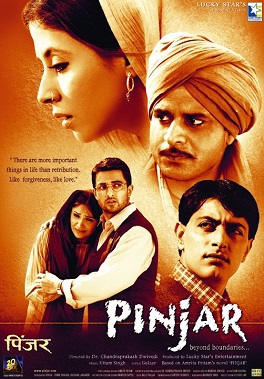
Pinjar, starring Urmila Matondkar in perhaps her most significant role, suffers occasionally from some low production values and spotty direction. But the subject the movie deals with is so stirring that this doesn't matter after you've seen the film. Form and beauty and technical perfection are just side-factors for this film; its main subject matter is powerful enough to keep the viewer fascinated with horror and distaste for hours after the film ends.
The film's theme is isolation. Its atmospheric fear stems from the society's pervasive oppression, and rejection, of women. Identifying with Puro (Urmila's character), the viewer slowly becomes aware of the level of isolation a woman was (and still is) subject to in traditional "honour"-oriented societies with a tribal social structure which regard women as property. The Partition of India, which led to some of the worst civic atrocities of the 20th century, enhances and completes the isolation. Puro's sense of being stranded alone among aliens drives the emotional charge of this movie.
Set in 1946, just before Partition, the film is about Puro, the eldest daughter of a Punjabi Hindu family, spending her time with her mother, sisters and a doting brother whom she is particularly close to. Puro's life is a picture of perfect family bliss until her father brings his family to their native village to settle her marriage. Unknown to Puro, her ancestors, who had been dominant in the village two generations ago, visited atrocities on the Muslims two generations ago. Times have changed now: Muslims are dominant in the village and are thirsting for some payback. This sets Puro up for a horrifying ordeal: she is abducted by a Muslim man, Rashid (Manoj Bajpai), and slowly loses all hope of being reunited with her family (or indeed anyone from Hindu society).
Manoj Bajpai was consummate as Rashid; I find it surprising the Bollywood doesn't use him more. Urmila did a good job with Puro. With most of the other actors I had a vague sense that they were a little wooden. But I hardly noticed this; it is just a vague impression in the back of my mind, which was almost completely absorbed by the events that were depicted. This is a movie where it is hard to separate the quality of performances from the subject matter. The same is true for the sets and realization of the surroundings; some of them looked inauthentic, like stage sets. The music in this movie was atrocious, and songs burst out of nowhere in the most incongrous Bollywood style possible. The entire first half-hour was over-developed and forgettable. But the story was so absorbing that all of this didn't matter.
To me, Pinjar was very educational about an alien aspect of North Indian (and Pakistani) culture. I once spoke with an expert on South Asia who gave me a convincing explanation for women-as-property attitude. Historically, for warring tribes that needed constant supplies of warriors, women were valuable as child-bearing instruments; so valuable that it was acceptable to abduct women for their child-bearing potential. These attitudes persist in some regions of Northern India and Pakistan even today; stories about abduction of Hindu women in Pakistan still appear from time to time in newspapers. (Presumably the same attitudes ossified and later included atrocities such as honour killings.) Pinjar depicts the extent to which such abductions had become part of the culture: everyone is depicted as being complicit in the abductions; entire villages colluded to hide abductees from government authorities. Paradoxically, the abducted women are not treated unkindly; they are in fact encouraged to integrate and lead "productive" lives. The unkindness is restricted to the abduction.
There are a few other aspects of the movie worth mentioning, such as Rashid's reluctance: he doesn't want to abduct Puro, but his family's "honour" demands it. Bajpai captures Rashid's conflicted personality well. The various depictions of other atrocities during the times of partition, such as the large scale killings, also stand out. Two scenes in particular come to mind. The first is the palpable tension when Ramchand (Sanjay Suri), Puro's erstwhile fiancee, runs from a frenzied mob after Partition is announced in 1947. The other is the sense of utter helplessness when Lajjo (Sandali Sinha), Ramchand's sister, is abducted right in front of him from a supposedly secure police-protected refugee camp. There's one scene where Puro meets her parents after being abducted; it was probably the strongest scene but for some reason struck me in a surreal rather than visceral way. The movie does have moments of reconciliation as well towards the end, but in some ways they were as disturbing as the rest of the film. In Stockholm-syndrome-esque ending, Puro reveals the extent to which she is tied emotionally to her new life with Rashid. Even though I know this is what really happened with scores of Hindu abductees, it is still hard for me as a viewer to accept or believe at an emotional level.
Pinjar should not be watched for its film-making brilliance (it's got too many flaws) or its entertainment value (those elements are seriously inferior in this film). It should be watched to get a small sense for the terrors experienced by people and abductees and their families during Partition.
Monday, July 21, 2008
Observation/Rant #001
The Land of the Moustachioed Men
 Watching Telugu movies, one comes to the incongruous conclusion that Telugu men are quite fond of their moustaches. Just as Japan is the Land of the Rising Sun and the USA is the Land of the Free, I think Andhra Pradesh deserves its own epithet. Join me in applauding the Land of the Mustachioed Men.
A conversation with the typical Telugu male confirms the hypothesis that moustaches are dear to the male Telugu heart. "Are you not a man?" I've heard some ask. "Moustaches are the mark of men." You've got to applaud the few male Telugu actors who dare to appear without one. Most of them compensate by sporting an unkempt 2-3 day stubble at several points in the movie, presumably to convince the Telugu viewer that they are indeed worthy of respect as a fellow man.
Sunday, July 20, 2008
Iqbal
 This is yet another brilliant offering from Nagesh Kukunoor. Like a good chef, he takes a simple recipe and executes it perfectly with good ingredients to produce a great result. The actors and technical departments are top-quality, the story is original and refreshingly simple, and the direction is perfect.
Iqbal is the story of a deaf-mute village boy, born at the moment of India's 1983 Cricket World Cup triumph (or perhaps when Kapil Dev won the semi-final match against Zimbabwe almost single-handedly). Iqbal has an innate but unschooled talent for cricket. The story is about his struggles to learn the game overcoming his own physical limitations, his father's restrictions, and the political intricacies of cricket academies; and whether he can triumph over the many obstacles that come in his way.
The film excels in its immersive realization of the its environment. The setting of the film is that of a village somewhere in India, where Iqbal spends his days tending his father's buffaloes. The story-telling in this movie and its pacing are in harmony with the simplicity of the environment. It is a very textural movie. You can almost feel the grass under your feet when Iqbal gets ready to bowl. The dull thud you hear when Iqbal drives his makeshift tree-branch stumps into the ground almost convinces you you can smell the sap. You can almost smell the haystack on which Iqbal's mentor Mohit (played by Naseeruddin Shah) wakes up after a night of drunkenness. When Iqbal first walked into Mohit's shadowy ancestral British-era haveli, I could almost feel the dank coolness inside. I've never seen a small-town cricket training academy or stadium, but after watching this movie, I imagine I have a feel for what they must be like.
This is one of those rare films where many different actors get a lot of screen time. Shreyas Talpade as the title character Iqbal dominates the screen for most of the time, of course, but the other actors' characters are all very well-developed as well. Shweta Prasad excels in the role of Khadija (Iqbal's sister). Naseeruddin is superb as Mohit; you can almost feel his drunken character's hangover each morning. Girish Karnad gives a balanced performance as the political Guruji, capturing the character's ambiguous morality. Prateeksha Lonkar and Yateen Karyekar are perfect as Iqbal's parents. But the star is, of course, Shreyas Talpade. Talpade seems to work with Kukunoor a lot, and it seems like one of those win-win professional relationships. This movie really showcases how fine an actor Talpade really is. It's hard to describe it all, but there's no single place in this movie where what he does looks the least bit unusual. His look of mild incomprehension at conversations he can't hear, his moments of elation, perplexity, gloom and his usual neutral good cheer, Talpade does them all, neither underdoing nor overdoing them.
And now for my pet peeve with Indian sports movies: again, this movie fails to showcase the sport it is based on. This movie may have captured the spirit of the cricket institutions themselves. But I would have loved to see some insane inswingers or yorkers. I wanted to see Iqbal scalp Kamal's (Adarsh Balakrishna) wicket with a ball so good that I'd burst out in spontaneous applause. These could have been bowled by a mainstream bowler and sliced in with Talpade's action. To Talpade's credit, he has a pretty reasonable bowling action. But the ball trajectories are played down a bit and they are nothing to write home about. In this context, I am reminded of the excellent football movie Goal starring Pele and Sly Stallone. I'd like to see a movie with that kind of reverence for the technical game itself.
This is not the kind of film that induces extreme emotional responses. It is low-key, not designed for one-a-minute thrills, maudlin emotional blows or cringe-inducing evil. Even the worst character in the movie (Guruji) is simply political, not evil or malevolent or even particularly antagonistic towards Iqbal. This movie treats its subject matter with respect. But that doesn't mean it's dry or fails to connect with the viewer. It's highly enjoyable, realistic cinema.
Sunday, July 13, 2008
Telugu Cinema: Variety Entertainment
Pursuant to my rant about maturity in Telugu films, I've come to a realization about the Telugu film industry. Calling most Telugu movies a "Film" or the industry "Cinema" is not consistent with the way the term is normally used in other film industries.
Usually a film refers to a coherent piece of work, an invention that is internally uniform and distinguishable from other pieces of work in its ethos, not just because it is on the same physical tape or disc. The story, plot, screenplay, cinematography, or a combination of these and other elements serve to give it a distinct character. You can't take a piece of one film and put it into a different film and have it make sense in the new context.
Movies in the Hindi and Telugu film industries often aim at a different ideal. When people from abroad stare in amazement at Indian cinema and wonder why there is a song-and-dance sequence all of a sudden, what they are missing is this: an Indian film is essentially variety entertainment. This kind of entertainment has been popular traditionally in India for centuries; a troupe of entertainers traveling from town to town putting on stage shows, with music, dance, acrobatics, a bit of drama, clowns and buffoonery, all thrown in.
The Indian movie is often a simple migration of this centuries-old motif to a different medium. The plot or story, if anything, only serves to hold the audience's interest and to give the movie a natural ending. The main offering is the song-and-dance routines, the music, the fights. Indeed, many Telugu movies are reviewed this way: not holistically, but as separate departments: songs, fights, comedy, dialogues, photography. A review might read: "Dialogues in this film are very good. First half has non-stop comedy. Fights by Peter Hynes are excellent. Photography is terrific. Dancing by hero and heroine is very well choreographed. The hero's style is terrific, he lives up to his image of Prince Charming with his mesmerizing looks (sic). The heroine is in her element with traditional costumes and cute mannerisms." And so on. "She is sensuality personified," says one review about the lead actress in a movie. "Her wardrobe in this film includes dresses ranging from traditional sarees to mini skirts." Hmm.
Telugu Movies to Avoid
I've come to the conclusion that it is as important to document bad movies as good. I often forget that I've watched a movie before, or forget what my reaction to a particular movie was. This post will help keep things organized. It will have Telugu movies which I would rate 1 or 2 stars (out of 5). 1 star means I hated this film and it was an effort to sit through it; 2 stars means I could sit through it but disliked it. I guess I'll keep adding films as I come across them.
Of course, these are to be contrasted to my post on good Telugu movies.
I recognize that many of these movies will be very popular ones. Nevertheless, these are poor movies. Hackneyed, shark-jumping plotting (or a total lack or a plot), cringe-inducing humour and dialogue, and lead actors who take their own shenanigans too seriously are the main problems with most of these movies.
These star ratings are not on the same scale as the ratings on the "movies to watch" page. The worst movie on that page is better than any of these.
- Classmates. (2 stars)
- Athadu. (2 stars)
- Boys. (2 stars) Starts off interesting (albeit crude), about adolescent boys, but turns into a hackneyed love story after a bit.
- Stalin. (1 star) Way too Rajnikant-ish for my taste.
- Jalsa. (2 stars)
- Nuvve Nuvve. (2 stars) The girl liked the guy because he sprayed cheap perfume on her. It also subscribes to a common Indian movie mantra: to impress the girl, treat her real badly. 'Nuff said.
- Pokiri. (2 stars) Full of bloody, senseless violence.
- Okkadunnadu. (2 stars) I really wish I could've put this in the "movies to watch" list, it had great promise. See brief review.
Subscribe to:
Posts (Atom)